
You Work for Your User: How to Design User-Centric Products in the Age of AI
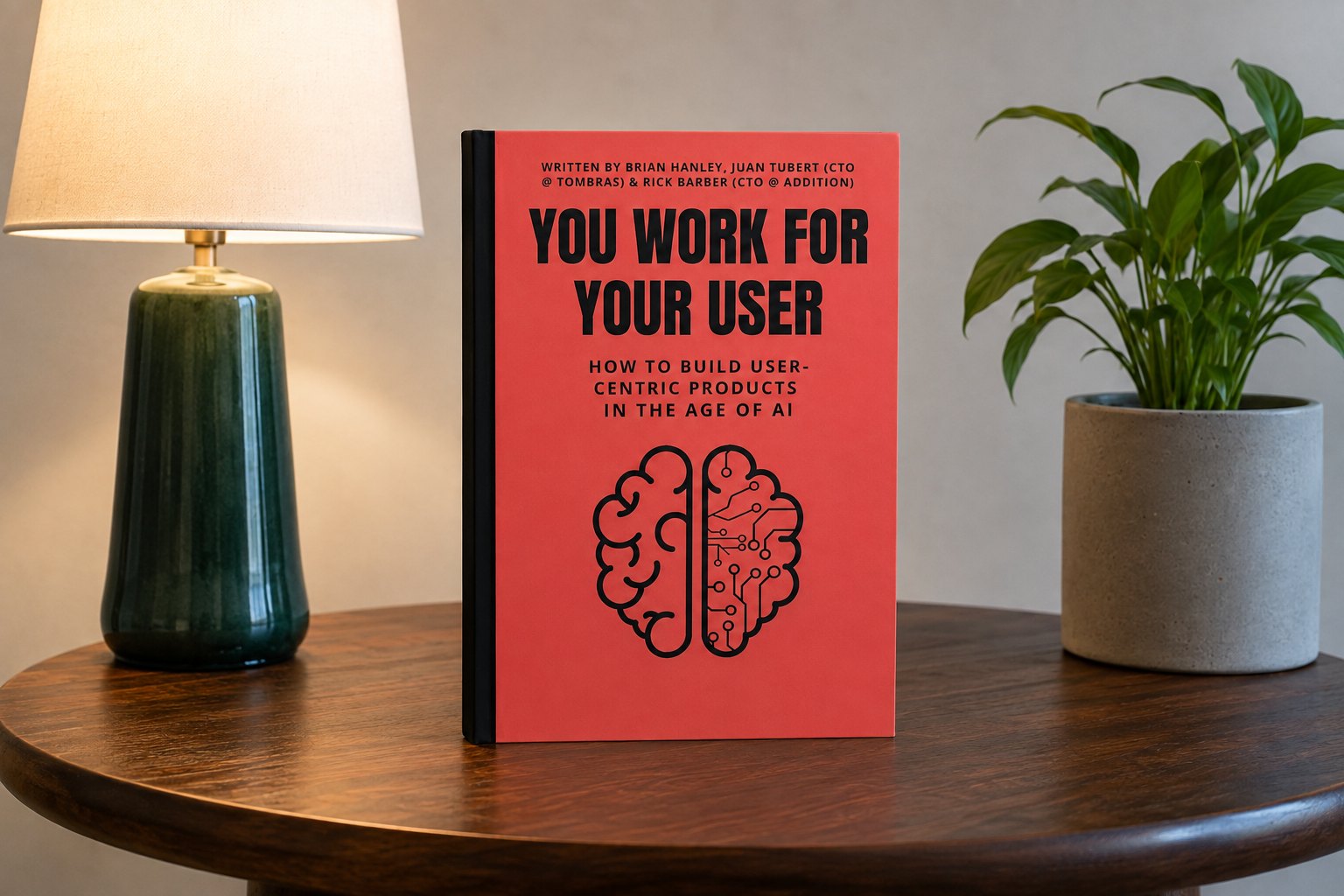
You Work for Your User: How to Design User-Centric Products in the Age of AI is a book I wrote with Brian Hanley and Rick Barber. Brian leads product management at Comcast and wrote The Roadmap Is a Lie; Rick is CTO and co-founder of Addition, an AI system design studio that joined R/GA in 2025.
- Role
- Co-author
- With
- Brian Hanley (Comcast) and Rick Barber (Addition)
- Published
- February 2026
The human-AI partnership
The argument running through the book is the one I keep making in talks: AI is an amplifier, not a replacement. A model can produce a thousand variations and cannot tell you which one will land. That gap, between generating options and knowing which one matters, is where people still do the work.
It also covers how teams should operate. Play with everything, deploy with care: test every model that ships, and be selective about what reaches production. Don’t centralise AI in a specialist team, because that removes the domain expert exactly when their judgement is most needed. Your finance lead catches errors in a budget projection that a creative technologist never would. And expect the lines between disciplines to blur, because a designer who can prototype and a developer who can design are more capable versions of themselves, not diluted ones.
The dark side of intelligence
The optimism only means something if you are honest about the cost, so the book sorts the risks into three kinds: harm to yourself, harm to others, harm to the planet.
The first is cognitive. Every act of delegation is individually rational and collectively dangerous, the same pattern as GPS and spatial memory. Hence the thirty percent rule: if more than half your output is AI-generated, you have crossed from collaboration into dependence.
The second covers deepfakes, disinformation at scale, surveillance, and bias that presents itself as mathematical truth.
The third is the one people skip: energy and water. Data centre electricity demand is on track to more than double between 2022 and 2026, and AI could push data centres past a trillion gallons of fresh water a year by 2027. That is the same argument Quili.AI was built to make tangible.
All 54 posts
· see this in the story
Juan (John) Tubert is Chief Technology Officer at Tombras.