
AI-Powered Advertising: 6000 Hyperlocal Ads Case Study
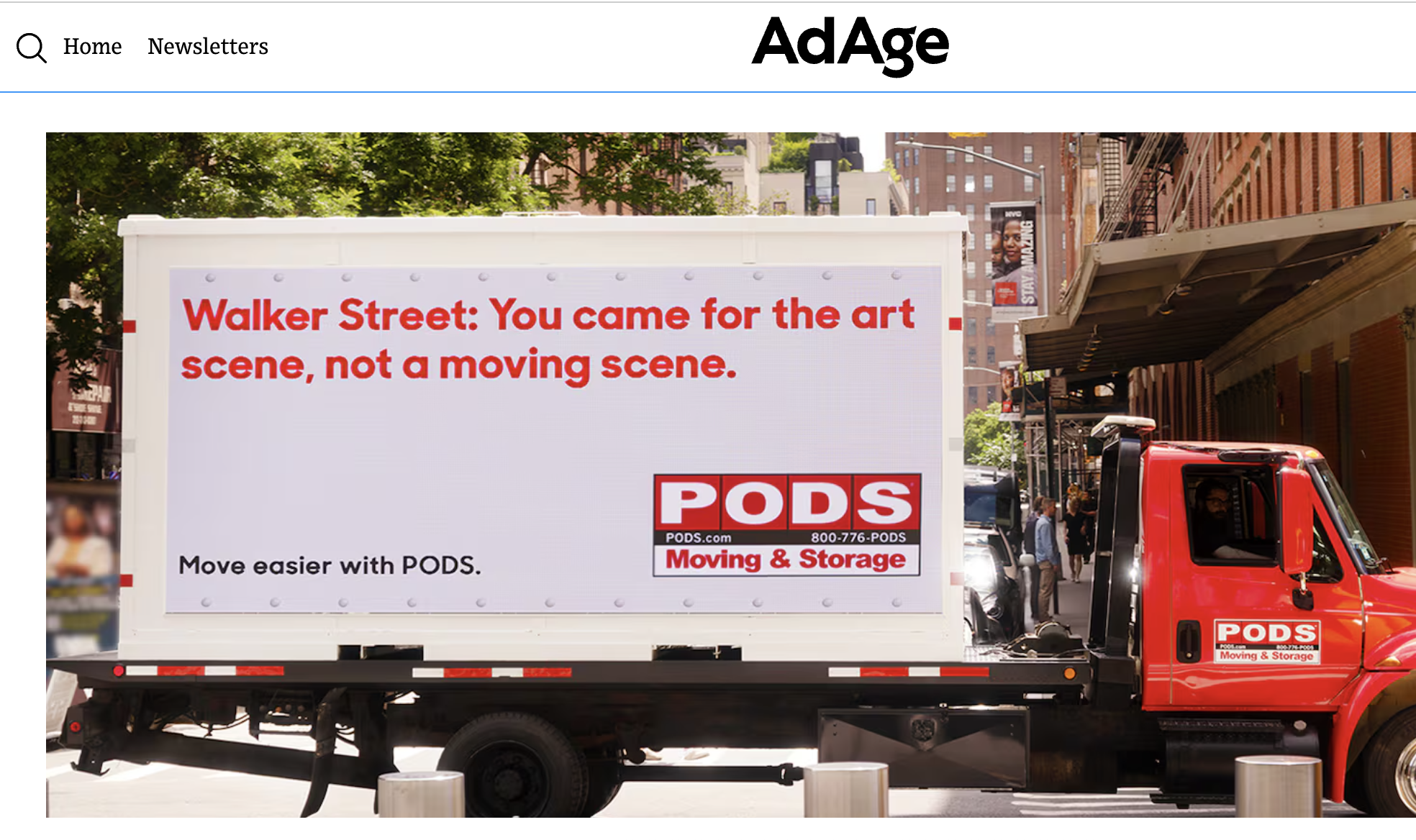
Ad Age covered this as a case study during Cannes. For Google’s AI Lighthouse program, Tombras was asked to build an out-of-home campaign for PODS that would have been impractical before generative AI. We turned a PODS moving truck into a billboard whose message changed with its location and with real-time context as it drove through New York City.
- My role
- Chief Technology Officer, Tombras. The API and cloud system behind the truck
- Technology
- Google Gemini, Vertex AI, Maps, Sheets and Cloud Run
- Recognition
- 2025 Webby for Best Experiential Design, AI Immersive & Games
How it worked
The system had to do three things at once: know where the truck was, decide what was worth saying in that specific neighbourhood, and get the line onto the display before the truck had moved on. As I put it to Think with Google, “we built an API that was able to combine all the headline data plus all the real-time data and then provide it back to the truck to display.”
That sounds simple and it is not. The interesting engineering was never the model call. It was latency, the shape of the data, what happens when a request fails halfway down Broadway, and how you keep thousands of generated lines inside a brand voice without a human approving each one in the moment.
What it produced
Think with Google reported that the campaign generated 6,000 lines of copy, and that the truck travelled through 299 neighbourhoods in 29 hours. They also reported a 60% increase in PODS website sessions and a 33% increase in quote requests in New York City.
Why it mattered
This was not AI replacing creative work. The creative team set the voice, wrote the premise and chose the strongest outputs; the system made it possible to operate at a scale that would otherwise have needed thousands of manual executions. One of the copywriters told Think with Google he would “personally never agree to writing 6,000 lines”, which is exactly the point. The machine did the volume. People decided what was worth saying.
I keep coming back to that division of labour. It is the same one I argued for at El Ojo de Iberoamérica, and the reason I think human creativity still leads even as the tooling gets better.
Google went on to use the campaign in its own advertising for Gemini, which is its own entry.
All 54 posts
· see this in the story
Juan (John) Tubert is Chief Technology Officer at Tombras.